
Smart Glass Technology

Discover all there is to know about switchable smart glass technology, including its benefits, applications, and how it works.

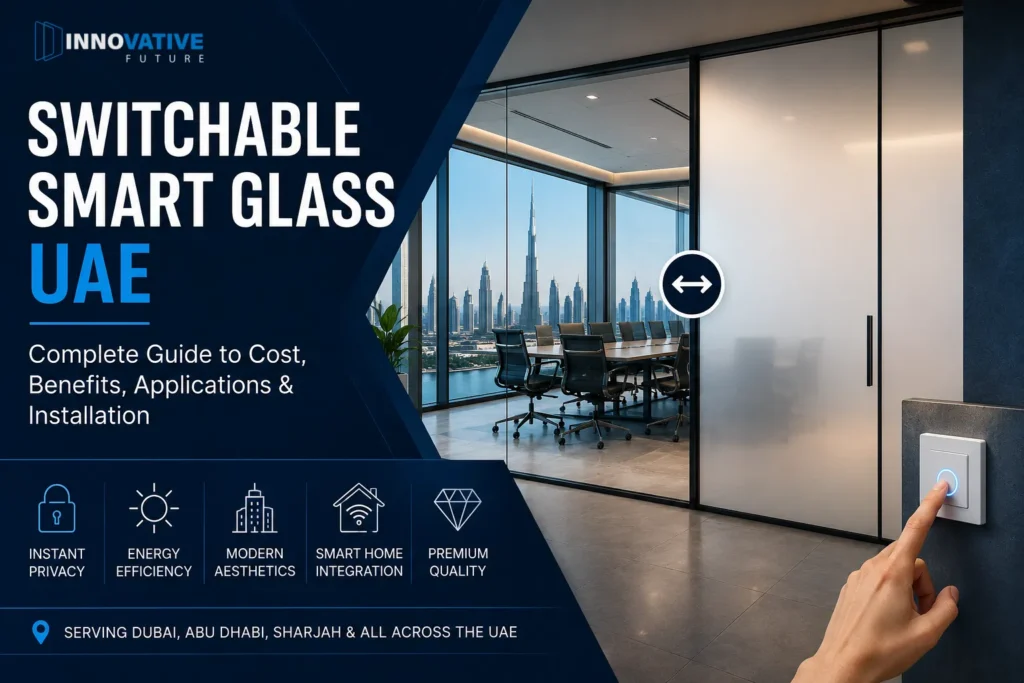
Switchable smart glass UAE guide showing modern office privacy glass technology and smart building applications

Switchable Smart Glass UAE: Complete Guide to Cost, Benefits, Applications & Installation

Switchable smart glass is transforming modern architecture by providing instant privacy, improved aesthetics, and seamless integration with smart building technologies. Across the UAE, property owners, architects, interior designers, and businesses are increasingly adopting this innovative solution for villas, offices, hotels, hospitals, and retail spaces. At Innovative Future Smart Glass, we provide advanced switchable smart glass and smart film solutions tailored to residential and commercial projects across Dubai, Abu Dhabi, Sharjah, and the wider UAE. Whether you need privacy for a conference room, luxury bathroom, healthcare facility, or smart home, switchable glass offers a modern alternative to traditional curtains and blinds. What Is Switchable Smart Glass? Switchable smart glass is an advanced glass technology that changes from transparent to opaque when electricity is applied or removed. It provides instant privacy without the need for curtains, blinds, or permanent frosted glass. Also known as intelligent glass, privacy glass, electronic privacy glass, or dynamic glass, this technology is becoming increasingly popular across the UAE in villas, offices, hotels, hospitals, and luxury commercial developments. At its core, switchable smart glass uses liquid crystal technology embedded between glass layers. When powered, the crystals align and allow light to pass through. When power is off, the crystals scatter light, creating a frosted appearance. This combination of privacy, aesthetics, and smart functionality makes it one of the most innovative architectural glass solutions available today. How Does Switchable Smart Glass Work? The most common technology used is PDLC Smart Glass (Polymer Dispersed Liquid Crystal). The process is simple: When power is removed: The transition occurs almost instantly and can be controlled through: Why Smart Glass Is Becoming Popular in the UAE The UAE is known for modern architecture, luxury developments, and extreme weather conditions. These factors make smart glass particularly attractive for both residential and commercial projects. Key reasons include: In cities like Dubai, Abu Dhabi, and Sharjah, architects increasingly specify smart privacy glass for premium developments because it combines functionality with a sleek design aesthetic. Types of Switchable Smart Glass PDLC Smart Glass PDLC is the most widely used smart glass technology. Best for: Benefits: SPD Smart Glass SPD (Suspended Particle Device) technology controls light and glare by adjusting tint levels. Best for: Benefits: Electrochromic Glass Electrochromic glass gradually changes tint when electrical voltage is applied. Best for: Benefits: Main Benefits of Switchable Smart Glass Instant Privacy The biggest advantage is privacy at the touch of a button. This makes it ideal for: Modern Architectural Design Smart glass creates a clean and luxurious appearance by eliminating bulky curtains and blinds. It is commonly used in: Energy Efficiency Smart glass can support HVAC efficiency by helping manage solar heat gain and natural lighting. Combined with Low-E Glass and Solar Control Glass technologies, it can contribute to more sustainable buildings. UV Protection Many smart glazing systems help reduce harmful UV exposure, protecting: Improved Space Utilization A meeting room can instantly transform from an open collaborative space into a private conference room. This flexibility is highly valued in modern office design. Common Applications of Smart Glass in the UAE Villas and Residential Properties Homeowners use smart glass for: Many luxury villas in Dubai and Abu Dhabi now integrate smart home technology with privacy glass systems. Office Buildings Smart office glass is increasingly used for: The result is improved office privacy while maintaining an open-plan environment. Hospitals and Healthcare Facilities Healthcare environments benefit from: Applications include: Hotels and Hospitality Hotels frequently install smart glass in: The technology enhances guest experience while creating a premium feel. Smart Glass Solutions Across UAE Innovative Future Smart Glass proudly serves customers throughout the UAE, delivering high-quality smart glass and smart film solutions for both residential and commercial applications. Our service areas include: Our solutions include: Whether you’re building a luxury villa, upgrading a corporate office, or designing a healthcare facility, our team can help you choose the right smart glass solution for your requirements. Smart Glass vs Frosted Glass Feature Smart Glass Frosted Glass Privacy Control Adjustable Permanent Appearance Dynamic Fixed Smart Automation Yes No Flexibility High Low Initial Cost Higher Lower Long-Term Functionality Excellent Limited For spaces that require changing privacy levels, switchable smart glass is typically the superior option. Smart Glass vs Curtains and Blinds Feature Smart Glass Curtains Blinds Maintenance Low Medium High Dust Collection Minimal High High Smart Controls Yes Limited Limited Modern Appearance Excellent Moderate Moderate Space Saving Excellent Moderate Moderate How Much Does Switchable Smart Glass Cost in UAE? The cost varies based on several factors. Key Pricing Factors Residential Projects Typical residential installations often include: Commercial Projects Commercial pricing depends on: The best approach is to request project-specific quotations from smart glass suppliers serving Dubai, Abu Dhabi, Sharjah, Ajman, and Ras Al Khaimah. For accurate pricing and project consultation, Innovative Future Smart Glass can provide customized quotations based on your project size, glass specifications, and installation requirements.  Can Smart Glass Handle UAE Heat? Yes. Smart glass is commonly used across the GCC because it performs well in hot climates. When paired with: it can help improve indoor comfort and reduce solar heat gain. This makes it highly suitable for UAE weather conditions where sunlight and heat management are major concerns. Smart Glass and Building Automation One of the most exciting developments is integration with smart buildings. Modern systems can connect with: Examples include: These capabilities support the UAE’s growing focus on smart cities and intelligent infrastructure. Installation Process A professional installation generally follows these steps: 1. Site Assessment Installers evaluate: 2. Design and Engineering Custom glass specifications are prepared. 3. Manufacturing Panels are fabricated according to project requirements. 4. Electrical Integration Power supplies and control systems are installed. 5. Installation Glass panels are mounted and connected. 6. Testing and Commissioning The entire system is tested for performance and safety. At Innovative Future Smart Glass, every installation is carried out by experienced professionals to ensure optimal performance, safety, and long-term reliability.  Maintenance Requirements Smart glass requires relatively little maintenance. Best practices include: Unlike blinds and curtains, there are

Switchable Smart Glass UAE: Complete Guide to Cost, Benefits, Applications & Installation Read More »

Smart Glass Is a Long-Term, Cost-Effective Investment

Experience the long-lasting privileges of energy savings, sustainability, productivity, and cost efficiencies harnessed by our privacy glass. Blending this innovative technology into your houses and workspaces is a prudent decision that benefits you in the long run. But how? Table of Contents For most people, the notion of replacing ordinary glass windows with smart glass sounds fascinating if you neglect the cost factor. However, the endless perks that switchable glass offers prove to be substantial compensation for its high prices.With smart glass, you can relish instant privacy with the push of a button without blocking the glare of sunlight. The ease of installing smart glass, together with its personalized nature and user-friendly design, makes it a reliable option for comfort and convenience. This incredible product also eliminates the need for artificial lighting and curtains or blinds, saving your energy and time for cleaning. Thus, smart glass technology is undoubtedly an all-in-one package for instantaneous seclusion, soundproofing, hazardous UV blockage, energy efficiency, and sustainability. We are moving towards comprehending how this technology is a cost-effective strategy to all the obstacles hindering your adoption of switchable glass today. Conventional Costs of Different Smart Glass Products How does smart glass technology incorporate heterogeneity and convenience? Switchable glass comes under the categories of active and passive. Active smart glass works under the influence of electric current, which shifts it from hazy to transparent. Contrarily, passive glass does not require electricity as it functions in response to fluctuating environmental factors, specifically light and temperature.Electrochromics, PDLC smart glass and film, and Suspended Particle Displays (SPDs) work actively in the presence of electric power, whereas thermochromic and photochromic glass demand threshold frequencies of heat (infrared) and light (ultraviolet) waves to adjust their transparencies.Switchable glass can be operated in a variety of ways, such as remote control, wall switch, integrating smartphone apps such as Siri or Alexa, and voice command. Factors Determining Smart Glass Price Having explored switchable glass types, let’s discuss how we can make a one-time profitable investment to harvest enduring benefits for years. The expensive nature of this innovative product is what grinds homeowners, architects, interior designers, and construction experts whenever they intend to amalgamate smart solutions in construction. But with strategic planning and in-depth research, we can make this dynamic glass a bit affordable. Smart glass prices are calculated considering size, quantity ordered, usage, customizability demands, installation costs, and delivery charges. The expense also varies according to your location and the company you purchase glass from. For instance, it costs less if you order this glass in bulk rather than buying a single piece. Likewise, getting a highly customized switchable glass glazing certainly doubles the price.   Why is Switchable Glass Film Relatively Cheap? Smart glass film is a peel-off PDLC sheet that can be applied to glass windows in homes or automobiles. This ready-to-use product works via remote control and makes your existing glass switchable. The cost-effectiveness of this product makes it a priority for those aspiring to integrate smart glass into their living settings. Smart film is comparatively inexpensive because it lacks glass lamination and does not require intricate wiring like privacy glass. Being a DIY product, it also saves you the additional cost of hiring a professional technician for installation purposes.  However, the smart film is not waterproof as it is not sealed externally, which makes it less durable. It typically lasts for as long as ten years, after which it starts turning greenish or yellow due to the accumulation of impurities. Average Cost is Defined Per Square Foot or Square Meter. Whether it’s PDLC smart film or Suspended Particle Display (SPD), thermochromic or photochromic glass, each type of smart glass possesses unique attributes and works its way.  The cost of privacy glass is defined per square foot or square meter of its area, varying with the size and glass type ordered. The placement factor also determines the price; for example, switchable glass shower doors are usually more expensive than small bathroom windows. Therefore, we have yet to have a final word about the standard value of switchable glass.    Cost of Electrochromic Smart Glass. Electrochromic glass gradually shifts from translucent to transparent under direct current. It is slightly expensive and costs as much as $80 to $120 US dollars per square foot or $1600 to $2600 US dollars per square meter. Cost of PDLC Switchable Glass and Switchable Film. PDLC Smart glass and film are the most widely used products worldwide as they don’t rely on external factors, such as light, to exhibit their functioning. The cost to purchase switchable glass falls between $70 to $150 US dollars per square foot or $270 to $1700 US dollars per square meter with installation.   Smart tint or film is relatively cheap, and a square foot of this film costs about $20 to $50 US dollars.   Cost of Photochromic and Thermochromic Smart Glass. Photochromic and Thermochromic glass is inexpensive, costing $70 to $100 US dollars to get a square foot of these products. When calculating the prices per square meter, the values shift from $700 to $1000 US dollars Cost of Suspended Particle Displays (SPDs). SPDs are another type of smart glass technology comprising microscopic light-absorbing particles suspended in a liquid matrix. On exposure to electric current, it shifts from transparent to opaque as opposed to PDLC glass and electrochromic.   How Does Size Influence Switchable Glass Prices? The size of privacy glass matters the most when determining its cost. It’s evident that the price of smart glass varies directly with increased dimensions. However, it is to be noted that large projects often come with a reasonable price range per square foot compared to smaller projects and individual panels. You receive bulk discounts on ordering large quantities of switchable glass windows.   How to Use Smart Glass Cost Calculator? We always strive to add value and comfort to your life with our industry-ready, top-quality products. But it’s also crucial to inform you how to operate these products to make your user

Smart Glass Is a Long-Term, Cost-Effective Investment Read More »

Why is Switchable Glass an Unparalleled Alternative to Traditional Glass?

Why is Switchable Glass an Unparalleled Alternative to Traditional Glass? Switchable glass windows and ceilings can be seen everywhere today and are close to becoming ‘the new normal.’ However, folks like you need help to choose the ideal product they need to purchase. It’s because you still wonder whether it’s the perfect time to embrace the switchable glass and make a transition.  Replacing the glazing in your residential spaces with switchable glass can be one of your best decisions in 2024. But how?  Switchable Glass technology harnesses infinite applications in almost all areas of human life. Switchable glass can be seen anywhere, from making your living spaces more aesthetic and isolated to transforming your workplace into a more dynamic and adaptive place, from upgrading your experiences in medical and educational settings to creating a biophilic design in your meeting rooms.  The product’s personalized settings and handy nature, rendering instant privacy on demand, make this innovative technology exceptional.  Switchable Glass Is Different from Switchable Film.   Smart glass is a technology-based product that alters its opacity when exposed to stimuli like electricity, heat, or light. Switchable glass is a particular variant of intelligent glass that operates with the push of a button or a switch (hence switchable). Polymer-dispersed liquid Crystal film is sandwiched between two sheets of tempered glass, which makes switchable glass enduring and water-resistant.  Conversely, switchable film is a flexible coating that can be applied to the interior of existing glass windows and doors. It works the same way as switchable glass, where electric current tends to reorient the liquid crystals within the film, shifting the glass to transparent. A remote control operates the switchable film. Why switchable glass? In a world where energy is depleting at the fastest pace ever, shifting towards energy-efficient means of technology is mission-critical. The optimal solution in this age of energy crisis is Switchable glass. Apart from offering privacy at your command, this game-changing piece of technology also fulfils your desire for natural light. Its use tends to reduce the use of artificial lights during the daytime and minimizes energy consumption. With switchable glass, achieving privacy in your bedroom is a matter of a second. The switchable glass fully meets your expectations, whether you are designing the wall of your living room or installing a partition in your office. A customizable intelligent glass product is what you need to enrich your living settings with architectural aesthetics and prevent undesirable heat gain. Attributes Which Make Switchable Glass Your Ideal Choice: In the realm of contemporary living, switchable glass is a keystone element, with its unmatched traits and functionality. We know that your need for seclusion and desire for natural light hold comparable significance. Therefore, switchable glass is a perfect alternative for you.Let’s embark on a journey of deciphering the decisive role of switchable glass by looking at the unprecedented features offered by this product. Ease Switchable glass is an easy-to-use product designed to work with a single click. Its personalized composition makes it a handy tool for architects and interior designers for construction purposes. Comfort Technological equipment exists solely to fulfil our urge for comfort and convenience. With its customized configurations, easy installation, remote control settings, and water-resistant nature, switchable glass is all set to add solace to your tiring and boring life. Aesthetics Switchable glass can be incorporated into the doors, walls, and ceilings of residential and commercial spaces without compromising intimacy. This distinctive aspect of switchable glass adds visual attractiveness and beauty to your homes, offices, and hotels. Customizability A technology-based product is useless if it cannot be tailored according to its user’s choice. Switchable glass possesses this feature, as you can achieve transparency levels and patterns according to your requirements. In addition, this glass can be configured to exhibit fascinating visuals, graphics, logos, and colours.For this purpose, switchable glass is used as a projection screen to display meeting room presentations and patient data in operation theatres. However, switchable glass cannot go from transparent to coloured or black immediately. A specific type, called blackout glass, requires at least fifteen minutes to turn black, hence sacrificing privacy. Privacy You no longer need curtains, blinds, and wooden partitions for isolation in hotels, resorts, offices, and other spaces because smart glass is designed to do so. This incredible technology has made your dream of instant privacy a ground reality. Switchable glass is your solution whether you want to avoid distractions in the office or require a secure environment at an airport. However, it works a bit differently at night as the light sources and shadows become evident.   Energy Efficiency All the pros of switchable glass become cons if it consumes a large amount of energy. Fortunately, that’s not the case, as this glass product is way more energy-efficient than you think. Not only does it function at low voltage, but it also allows two-thirds of sunlight to pass when frosted, thereby eliminating the use of bulbs and tube lights.  Innovative Design The elegant and simple design of switchable glass certainly adds value to this product. It does not require much effort to carry and can be installed the same way as traditional glass. Its minimalistic nature and simplicity make it a unique product. Sustainability Does the switchable glass have some contribution towards global warming and contamination of the already polluted atmosphere? If yes, then there is a discrepancy in your understanding.Switchable glass does not cause any harm to the environment in the form of greenhouse effect or pollution. Instead, it is an eco-friendly technology that is highly safe and promotes sustainability. Where Can I Get Switchable Glass in Dubai? With the advancements in the glass industry in Dubai, finding a worthwhile switchable glass store is no longer a big deal. Several companies in Dubai sell switchable glass and film products. Some of the big names are as follows: The Emirates Besides fire-rated and bullet-resistant glass, the Emirates also manufactures switchable glass known as Smart Lite. You can find them at Al-Quoz, or you can visit their website to place an

Why is Switchable Glass an Unparalleled Alternative to Traditional Glass? Read More »

Top Glass Manufacturing Company in Dubai

Imagine sitting by the window in your living room, holding your smartphone, and capturing the picturesque sight on your lawn, where little birds collect twigs and grass to build their home. Have you ever pondered that the mobile phone you are taking pictures with and the window you are looking through possess parallels in some ways? To your wonder, something ‘prosaic’ yet ‘valuable’ is known as glass.   Let’s dive deep to explore the significant role of glass, from looking at the manufacturing process to deciphering different glass types and highlighting the big names in the international glass market, particularly in Dubai. After this exciting journey, you will never take glass for granted.  Glass Fundamentals and Characteristic Features Glass, one of the most widely used amorphous (non-crystalline) solids, is an amalgamation of silica SiO2, soda ash Na2CO3, and limestone CaCO3, and is typically transparent. The fundamental properties and unmatched features make glass an integral part of our lives.  Some of the characteristics, that distinguish glass from other materials, are listed below: ⦁ Transparency   Glass is transparent (sometimes translucent) in nature, allowing electromagnetic light to pass through it. Its ability to cause light rays to reflect or refract qualifies it to be used in lenses, mirrors, prisms, and other display screens. ⦁ Durability      The heating process during glass manufacturing makes it hard enough to be used for longer periods. ⦁ Inertness      Glass is immune to chemicals, i.e., it can withstand attack from reagents like water, which makes it an ideal fit to preserve liquids like juices, soft drinks, acids, etc. ⦁ Brittleness       Contrary to plastic, glass is intrinsically brittle and tends to shatter under pressure. This is due to its specific molecular geometry, which makes it inelastic.   Glass Comes in Different Varieties During the production process, glass can be molded into various forms by the addition of other ingredients like FeO and PbO. Once manufactured, glass can also be tempered or laminated to enhance its strength by either a thermal or chemical treatment. Glass is classified based on several criteria such as the nature of constituents, glass properties, strength, and constructional and architectural uses. Concerning its composition, glass can be silicate, borosilicate, lead, phosphate, or aluminosilicate. Safety glass, insulating glass, fire-resistant glass, decorative glass, and soundproof glass are defined based on their properties. When it comes to its usage in construction, glass can be floated, chromatic, shatterproof, tempered, or laminated. How is glass manufactured? You might wonder whether the glass exists naturally or is made through some artificial means. Apart from volcanic glass, which accounts for about 10% of the total, the rest is produced from the sand. Glass manufacturing initiates with the mixing of component elements; sand, soda ash, and limestone; which is placed in a furnace for thermal exposure. The molten mixture is homogenized and structured into the desired form afterward. The final step marks the glass cooling phase where it is passed through a specialized cooling oven called an annealing lehr. This step is done to make the glass tough and durable.  A Glance at The Global Glass Industry Whether passing by the gigantic Burj Khalifa in Dubai or drinking your favorite juice in a goblet, you encounter glass everywhere. The glass economy worldwide witnessed a dynamic increase in production, sales, and trade in the past few years. This is because glass is an excellent alternative to plastic as it is more readily recycled and sustainable. Due to its eco-friendliness, glass is used worldwide for packaging purposes instead of plastic. Glass is also a raw material for many commercial sectors like automobiles and electronics. Consider a car accident where the driver had a narrow escape due to a laminated glass windshield or imagine the enchanting features offered by the tiny chip in your smartphone, observe the architectural aesthetics in the buildings around you, or study the functioning of the optical fiber installed at your home; you’ll find that glass is a crucial element in all of these. It would not be an exaggeration to say that many areas of life remain incomplete without the intervention of glass. The glass industry is estimated to have a global economy of about 150 billion US dollars. From the United States to China, England to Japan, and France to India; every major country in the world spends billions of funds on glass and glassware. Let’s have a look at the international glass market and understand who the major players in the game are. China: Biggest Glass Exporter Worldwide Statistics reveal that China was the biggest exporter of glass in the year 2022, followed by Germany. Other countries that shared the trade table were the United States, Japan, France, Italy, and Belgium. Beijing Glass Group is one of the largest glass production units in China. Established in 1992, Beijing Glass Company caters to the sale of daily glass, industrial glass, quartz, and other silicate products. United States: Biggest Glass Importer The United States of America was the biggest importer of glass and glassware in 2021, followed by Germany. The United States itself contributes significantly to the global glass economy with its glass manufacturing industry known as Pittsburgh Plate Glass (PPG) Company. PPG was founded in 1883, and its headquarters are located in Pennsylvania. Who is the Biggest Glass manufacturer in the World? The world’s biggest name in glass manufacturing today is Saint-Gobain, which is headquartered in Paris. It was founded in 1665 and was famous for mirror production initially. It operates in 75 different countries today and has successfully generated sales of about 47 billion euros in the last year. Let’s explore some of the major glass companies in the world, other than Saint-Gobain AGC Group AGC, also called Asahi Glass Co. Ltd., is a prominent Japanese glass-producing industry, that resides in the capital of Japan. Mitsubishi Group is the owner of this company, which has expertise in making ceramics, different chemicals, and top-notch glass. It was established in 1907 and is also ranked as the

Top Glass Manufacturing Company in Dubai Read More »

Concept of Innovative Future Smart Glass Technology

How Does Smart Glass Technology Work in 2026?

How Does Smart Glass Technology Work in 2026? The Moment Everything Changed in a Dubai Boardroom Picture this: a high-stakes client meeting in a glass-walled conference room on Sheikh Zayed Road. With one tap on a tablet, the transparent walls turn frosted in under a second — the whole room becomes a private sanctuary. No blinds, no curtains, no awkward fumbling. Just instant privacy on demand. That is the quiet revolution smart glass technology is delivering right now across Dubai, Abu Dhabi, and beyond. And in 2026, it is no longer a luxury novelty — it is a standard expectation in intelligent architecture, luxury villas, world-class hospitals, and sustainable commercial buildings across the UAE. What is Smart or Switchable glass? Smart glass, also called switchable glass, dynamic glass, or privacy glass, is a glazing technology that changes its light transmission properties — shifting between transparent and opaque — in response to electricity, heat, or light. The most widely used type, PDLC (Polymer-Dispersed Liquid Crystal) glass, uses an electric current to align liquid crystal molecules inside a film, instantly switching the glass from frosted to clear. It eliminates the need for blinds, curtains, or tinted film while delivering privacy, energy savings, and design flexibility in a single pane of glass. Introduction to Smart Glass Technology in 2026 Smart glass has moved well beyond the laboratory. The global smart glass market was valued at over USD 6 billion in 2024 and is projected to exceed USD 13 billion by 2030, driven largely by smart city developments, green building mandates, and the hospitality boom across the Gulf region. In the UAE specifically, the push toward Net Zero by 2050 and Green Building regulations under Estidama and Dubai’s Al Sa’fat rating system have made energy-efficient glazing a priority for architects, developers, and government infrastructure projects alike. What was once considered a premium upgrade for luxury penthouses in Palm Jumeirah is now specified in hospitals, retail flagships, hotel suites, airport lounges, and corporate headquarters from Dubai Internet City to Abu Dhabi’s Saadiyat Island. Understanding how the technology actually works — and which type suits your project — is the first step to making the right decision. What Is Smart Glass or Switchable Glass? Smart glass is a category of technologically enhanced glazing that can alter its optical properties on demand. Depending on the type, it can shift from fully transparent to opaque, or modulate the amount of visible light, infrared radiation, or ultraviolet rays passing through it. It is known by several names in the industry: Smart Glass — the general consumer term Switchable Glass — emphasizes the on/off privacy function Dynamic Glass — used in commercial and architectural contexts Intelligent Glass — common in smart building specifications Privacy Glass — highlights the key use case PDLC Glass — refers specifically to the Polymer-Dispersed Liquid Crystal variant All of these terms refer to glass (or glass combined with a smart film) that responds to an external stimulus — electricity, heat, or light — to change how it looks and how much energy it transmits. How Does Smart Glass Technology Actually Work? The mechanism behind smart glass varies by type, but the most widely installed technology in the UAE today is PDLC — and understanding it demystifies the rest. PDLC Glass (Polymer-Dispersed Liquid Crystal) A thin LCD film is laminated between two sheets of glass (or applied as a self-adhesive smart film to existing glass). Inside this film are millions of microscopic liquid crystal droplets suspended in a polymer matrix. When the power is OFF: The liquid crystals are randomly oriented. They scatter incoming light in every direction, making the glass appear white and frosted — fully opaque. When the power is ON: An electric current passes through the conductive layers on either side of the film. This aligns all the liquid crystal molecules in parallel. Light now passes straight through, and the glass becomes clear and transparent. The transition happens in milliseconds. The glass can be controlled by a wall switch, remote control, smartphone app, voice assistant, or integrated into a building automation system (BAS). Electrochromic Glass Electrochromic glass changes its tint gradually when a low-voltage current is applied. Unlike PDLC, it does not switch between fully opaque and fully transparent — instead, it modulates tint levels, reducing glare and solar heat gain while maintaining a degree of outward visibility. It is commonly used in large curtain-wall facades and high-performance office buildings in Dubai and Abu Dhabi where solar control is the primary concern. SPD Glass (Suspended Particle Device) SPD glass contains a thin film of rod-like particles suspended in a fluid. Without electricity, the particles are randomly scattered, absorbing light and appearing dark. When voltage is applied, the particles align and the glass lightens. SPD glass offers fine-grained control over light transmission and is particularly popular in automotive sunroofs and luxury skylights. PDLC Glass Models: Standard vs. Next Generation PDLC glass, being the most popular choice for residential and commercial projects in the UAE, comes in two core configurations. Standard PDLC Glass The classic model switches between fully frosted (off) and fully transparent (on). It requires a simple circuit — typically just two wires connected to a small transformer — and is operated by a standard switch or remote. This model is the most cost-effective and the most commonly installed in partitions, bathroom enclosures, meeting rooms, and residential windows across Dubai and Sharjah. Next-Generation PDLC Glass More complex internally, next-generation PDLC can do considerably more than simply switch on and off. It supports: Partial transparency zones within a single pane Custom patterns, logos, and graphic designs embedded in the glass Integration with smart home and building automation platforms (KNX, Crestron, Control4) Projection capabilities — the frosted state acts as a rear-projection screen for presentations or digital signage Gradient effects, where the glass transitions from opaque at the bottom to clear at the top (or vice versa) This makes it a favoured choice for luxury hotel lobbies, retail brand activations, and high-end residential projects

How Does Smart Glass Technology Work in 2026? Read More »

Get a Free Quote!

Share your details to get the ball rolling