How Does Smart Glass Technology Work in 2026?

The Moment Everything Changed in a Dubai Boardroom
Picture this: a high-stakes client meeting in a glass-walled conference room on Sheikh Zayed Road. With one tap on a tablet, the transparent walls turn frosted in under a second — the whole room becomes a private sanctuary. No blinds, no curtains, no awkward fumbling. Just instant privacy on demand.
That is the quiet revolution smart glass technology is delivering right now across Dubai, Abu Dhabi, and beyond. And in 2026, it is no longer a luxury novelty — it is a standard expectation in intelligent architecture, luxury villas, world-class hospitals, and sustainable commercial buildings across the UAE.
What is Smart or Switchable glass?
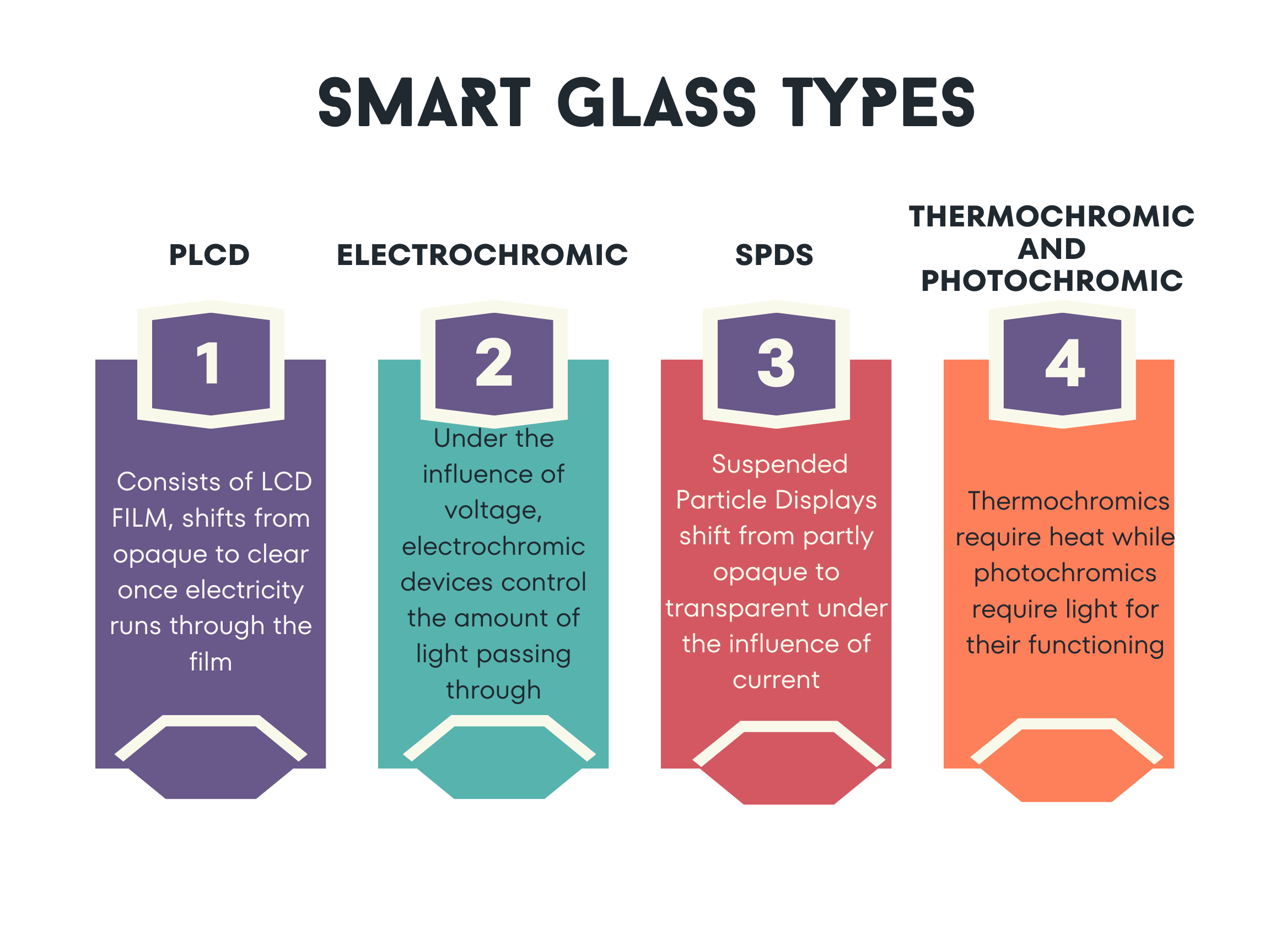
Smart glass, also called switchable glass, dynamic glass, or privacy glass, is a glazing technology that changes its light transmission properties — shifting between transparent and opaque — in response to electricity, heat, or light. The most widely used type, PDLC (Polymer-Dispersed Liquid Crystal) glass, uses an electric current to align liquid crystal molecules inside a film, instantly switching the glass from frosted to clear. It eliminates the need for blinds, curtains, or tinted film while delivering privacy, energy savings, and design flexibility in a single pane of glass.
Introduction to Smart Glass Technology in 2026
Smart glass has moved well beyond the laboratory. The global smart glass market was valued at over USD 6 billion in 2024 and is projected to exceed USD 13 billion by 2030, driven largely by smart city developments, green building mandates, and the hospitality boom across the Gulf region. In the UAE specifically, the push toward Net Zero by 2050 and Green Building regulations under Estidama and Dubai’s Al Sa’fat rating system have made energy-efficient glazing a priority for architects, developers, and government infrastructure projects alike.
What was once considered a premium upgrade for luxury penthouses in Palm Jumeirah is now specified in hospitals, retail flagships, hotel suites, airport lounges, and corporate headquarters from Dubai Internet City to Abu Dhabi’s Saadiyat Island. Understanding how the technology actually works — and which type suits your project — is the first step to making the right decision.
What Is Smart Glass or Switchable Glass?
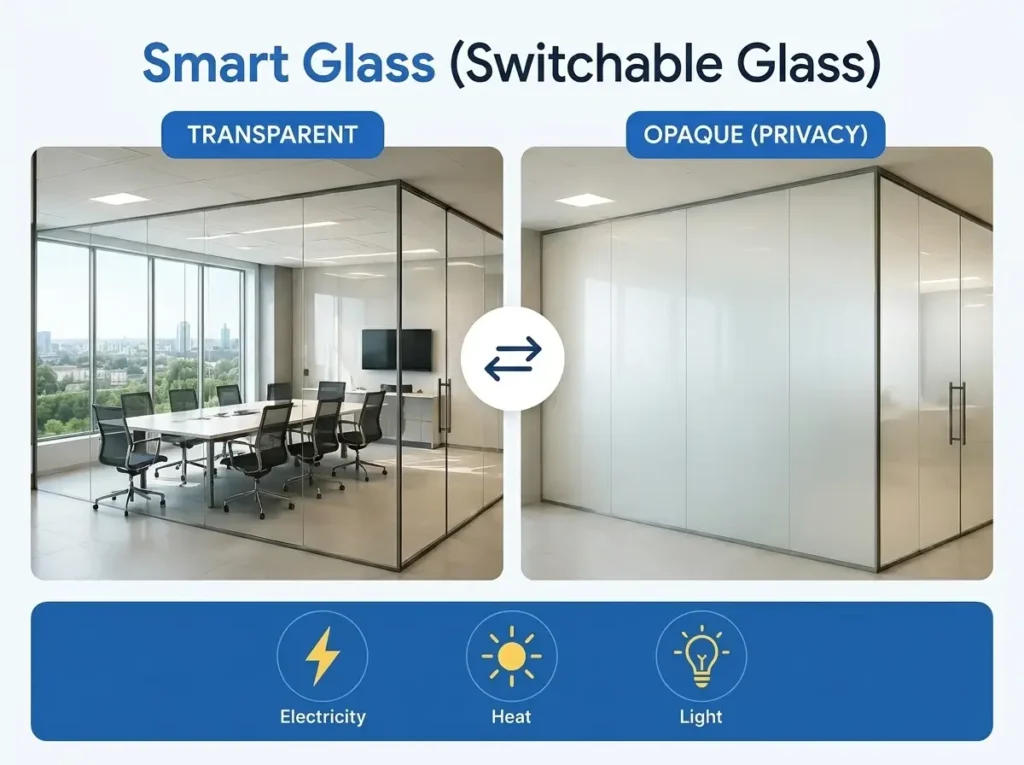
Smart glass is a category of technologically enhanced glazing that can alter its optical properties on demand. Depending on the type, it can shift from fully transparent to opaque, or modulate the amount of visible light, infrared radiation, or ultraviolet rays passing through it.
It is known by several names in the industry:
- Smart Glass — the general consumer term
- Switchable Glass — emphasizes the on/off privacy function
- Dynamic Glass — used in commercial and architectural contexts
- Intelligent Glass — common in smart building specifications
- Privacy Glass — highlights the key use case
- PDLC Glass — refers specifically to the Polymer-Dispersed Liquid Crystal variant
All of these terms refer to glass (or glass combined with a smart film) that responds to an external stimulus — electricity, heat, or light — to change how it looks and how much energy it transmits.
How Does Smart Glass Technology Actually Work?
The mechanism behind smart glass varies by type, but the most widely installed technology in the UAE today is PDLC — and understanding it demystifies the rest.
PDLC Glass (Polymer-Dispersed Liquid Crystal)
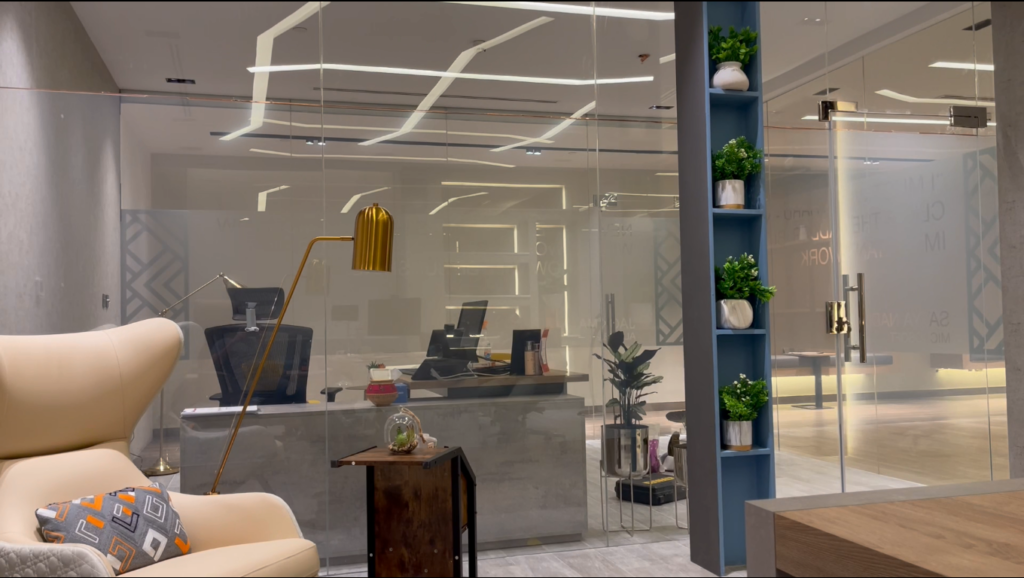
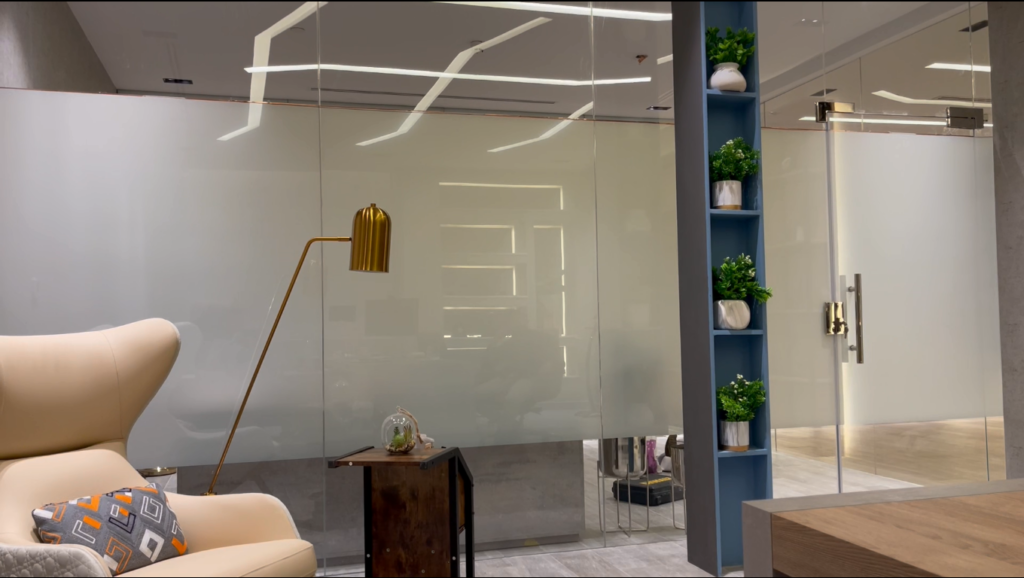
A thin LCD film is laminated between two sheets of glass (or applied as a self-adhesive smart film to existing glass). Inside this film are millions of microscopic liquid crystal droplets suspended in a polymer matrix.
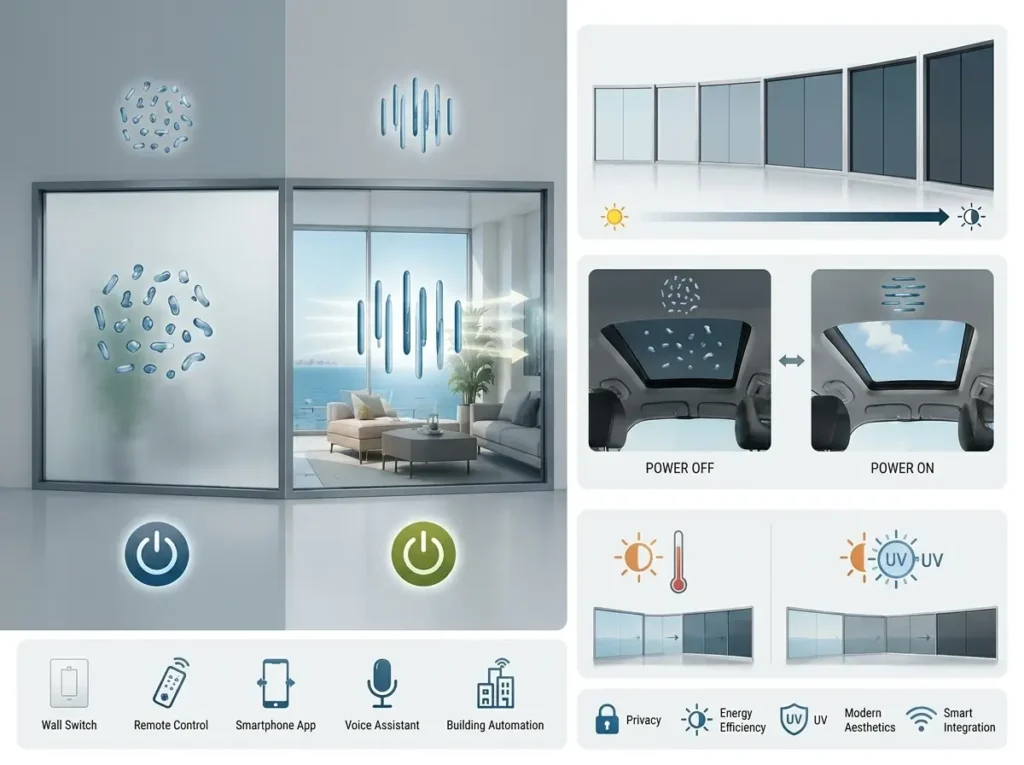
When the power is OFF: The liquid crystals are randomly oriented. They scatter incoming light in every direction, making the glass appear white and frosted — fully opaque.
When the power is ON: An electric current passes through the conductive layers on either side of the film. This aligns all the liquid crystal molecules in parallel. Light now passes straight through, and the glass becomes clear and transparent.
The transition happens in milliseconds. The glass can be controlled by a wall switch, remote control, smartphone app, voice assistant, or integrated into a building automation system (BAS).
Electrochromic Glass
Electrochromic glass changes its tint gradually when a low-voltage current is applied. Unlike PDLC, it does not switch between fully opaque and fully transparent — instead, it modulates tint levels, reducing glare and solar heat gain while maintaining a degree of outward visibility. It is commonly used in large curtain-wall facades and high-performance office buildings in Dubai and Abu Dhabi where solar control is the primary concern.
SPD Glass (Suspended Particle Device)
SPD glass contains a thin film of rod-like particles suspended in a fluid. Without electricity, the particles are randomly scattered, absorbing light and appearing dark. When voltage is applied, the particles align and the glass lightens. SPD glass offers fine-grained control over light transmission and is particularly popular in automotive sunroofs and luxury skylights.
PDLC Glass Models: Standard vs. Next Generation
PDLC glass, being the most popular choice for residential and commercial projects in the UAE, comes in two core configurations.
Standard PDLC Glass The classic model switches between fully frosted (off) and fully transparent (on). It requires a simple circuit — typically just two wires connected to a small transformer — and is operated by a standard switch or remote. This model is the most cost-effective and the most commonly installed in partitions, bathroom enclosures, meeting rooms, and residential windows across Dubai and Sharjah.
Next-Generation PDLC Glass More complex internally, next-generation PDLC can do considerably more than simply switch on and off. It supports:
- Partial transparency zones within a single pane
- Custom patterns, logos, and graphic designs embedded in the glass
- Integration with smart home and building automation platforms (KNX, Crestron, Control4)
- Projection capabilities — the frosted state acts as a rear-projection screen for presentations or digital signage
- Gradient effects, where the glass transitions from opaque at the bottom to clear at the top (or vice versa)
This makes it a favoured choice for luxury hotel lobbies, retail brand activations, and high-end residential projects across the UAE.

Key Benefits of Smart Glass Technology
Privacy on Demand
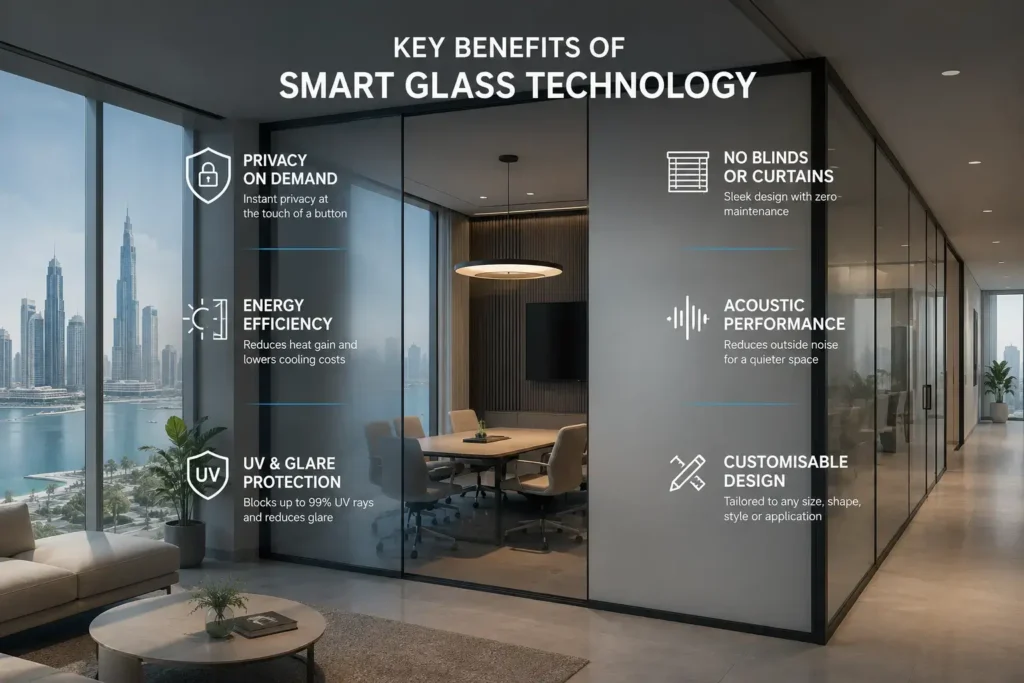
The most immediate benefit is instant, controllable privacy without physical barriers. In a hospital, a patient bay can be made private in a second. In an office, a glass-walled meeting room becomes confidential the moment a call starts. In a home, a bathroom or bedroom can shift from open to private without compromising the feeling of space and natural light.
Energy Efficiency and UAE Climate Adaptability
In a country where air conditioning accounts for a significant portion of energy consumption — the UAE’s summer temperatures regularly exceed 45°C — smart glass makes a measurable difference. By blocking infrared and UV radiation on demand, switchable glass reduces solar heat gain, lowering the cooling load on HVAC systems. Studies in similar climates have demonstrated energy savings of 20–30% in buildings with smart glazing compared to standard glass.
This directly supports the UAE’s Green Building regulations under Dubai’s Al Sa’fat system and Abu Dhabi’s Estidama Pearl Rating System, both of which reward passive and active solar control strategies.
UV and Glare Protection
Smart glass can block up to 99% of UV radiation even in its transparent state (depending on the specification), protecting interior furnishings, artwork, flooring, and the occupants themselves from UV damage. It also reduces glare — a significant comfort factor in the UAE’s high-sun environment — without darkening the space or losing the view.
Elimination of Blinds and Curtains
Smart glass replaces the maintenance burden and aesthetic clutter of blinds, curtains, and roller shades. In high-humidity coastal environments like Dubai Marina or Yas Island, fabric window treatments can deteriorate quickly. Switchable glass eliminates that problem entirely while offering a cleaner, more architectural look.
Acoustic Performance
Many smart glass configurations — particularly laminated PDLC assemblies — provide meaningful sound insulation. For offices near Dubai’s busy road networks or residential units in high-density areas, this secondary acoustic benefit adds significant value.
Customisability and Aesthetic Value
Smart glass is not a single off-the-shelf product. It can be cut and shaped to virtually any dimension, configured in any RAL colour tint, embedded with custom graphics or branding, and integrated into virtually any architectural system — frameless glass partitions, structural glazing, sliding doors, skylights, and curved facades.
Why Smart Glass Matters in the UAE in 2026
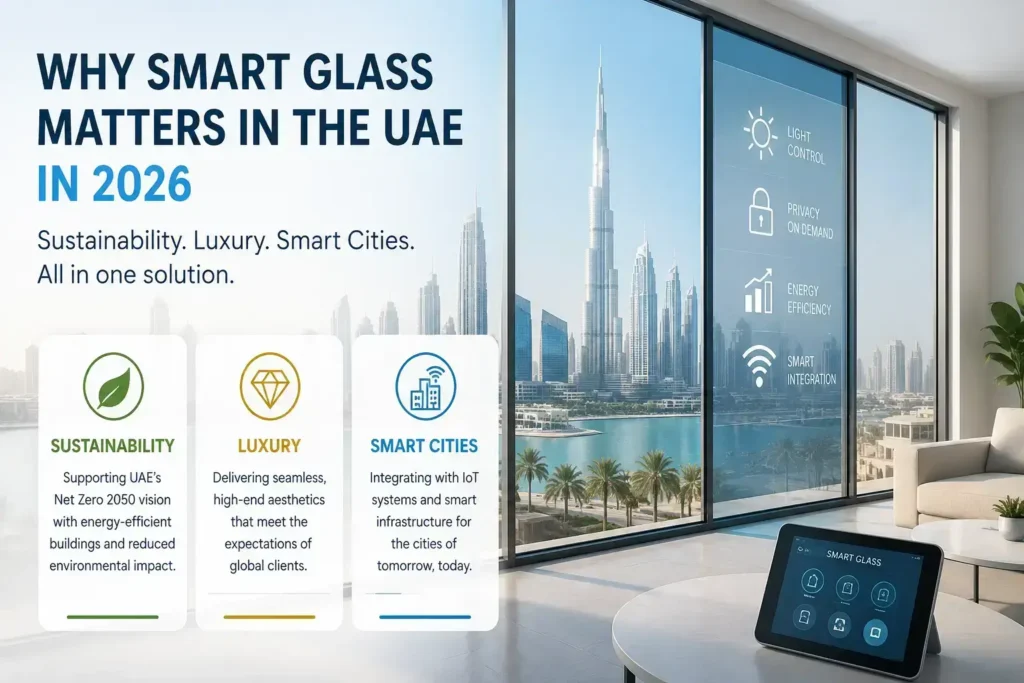
The UAE’s built environment in 2026 is defined by three converging forces: sustainability mandates, luxury expectations, and smart city infrastructure. Smart glass sits at the intersection of all three.
Sustainability: Dubai’s 2030 Sustainability Agenda and the UAE Net Zero by 2050 Strategic Initiative have pushed green building compliance from optional to essential for new developments. Smart glazing contributes directly to reduced energy consumption and improved environmental ratings.
Luxury: From Jumeirah Beach Residence to Saadiyat Cultural District, the UAE’s hospitality and residential sectors compete globally on design quality. Smart glass delivers the seamless, technology-integrated aesthetic that discerning clients and international architects now expect as standard.
Smart Cities: Dubai’s Smart City initiative and NEOM’s ongoing development in the broader Gulf region have elevated demand for intelligent, connected building materials. Smart glass that integrates with IoT platforms, responds to occupancy sensors, and feeds data to building energy management systems is no longer futuristic — it is being specified today.
Smart Glass vs. Traditional Alternatives — A Quick Comparison
| Feature | Smart Glass | Traditional Blinds | Frosted Film | Curtains |
|---|---|---|---|---|
| Privacy | Instant and switchable | Adjustable | Permanent | Adjustable |
| Natural Light | Excellent control | Good when open | Limited | Good when open |
| Maintenance | Low | Medium | Low | High |
| Appearance | Premium and modern | Traditional | Basic | Style-dependent |
| Smart Integration | Supported | Limited | Not available | Not available |
| Lifespan | 10–15+ years | 3–7 years | 5–10 years | 3–5 years |
Future Trends in Smart Glass Technology
Smart glass in 2026 is already significantly more capable than it was even three years ago. The next wave of development is moving in several clear directions.
AI-Integrated Glazing: Building automation systems are beginning to use occupancy data, weather forecasting, and energy pricing signals to automatically manage smart glass states throughout the day — optimising both comfort and energy cost without any manual input.
Solar-Generating Smart Glass: Photovoltaic smart glass — panels that generate electricity while also switching between transparent and opaque states — is moving from prototype to early commercial deployment. For the UAE’s solar-intense environment, this is a particularly compelling development.
Self-Tinting Without Electricity: Next-generation thermochromic and electrochromic materials are being developed that require no continuous power draw to maintain a tinted state — power is only needed to change states, not to hold them.
Flexible and Curved Smart Film: Advances in substrate technology are making it possible to apply switchable film to curved and irregularly shaped surfaces — opening up new design possibilities for automotive, aerospace, and high-design architectural applications.
Voice and Gesture Control: Integration with ambient computing platforms means smart glass can increasingly be controlled without any physical interface — a natural next step in the UAE’s smart home and smart building ecosystem.
Common Challenges and How to Address Them
Power dependency: PDLC glass defaults to its frosted (off) state when power is lost. For most applications this is actually a safety advantage — privacy is maintained during outages. For facades where transparency is critical, electrochromic glass with a low-power hold function may be more appropriate.
Initial cost: Smart glass carries a higher upfront cost than standard glazing — typically ranging from AED 180 to AED 650 per square metre depending on type, size, and specification. However, when factored against the elimination of blinds, curtains, and associated installation and maintenance costs — plus energy savings over the building’s lifespan — the total cost of ownership is competitive. Most quality installations carry a 5–10 year warranty.
Installation precision: Smart glass must be installed correctly to perform as specified. Poor lamination, inadequate edge sealing, or incorrect electrical connections can cause uneven switching or reduced lifespan. Specifying a certified supplier and installer is essential.
Existing glass retrofits: Not all existing glazing can accommodate a laminated PDLC unit. In many retrofit cases, self-adhesive smart film — applied directly to existing glass — offers a practical and cost-effective alternative that delivers similar privacy and switching functionality.
Why Choose IF Smart Glass in the UAE?
IF Smart Glass is an authorised manufacturer and supplier of premium switchable glass and smart film solutions across the United Arab Emirates, operating from our facility in Al Quoz, Dubai.
What sets us apart:
- Custom manufacturing — every panel is cut and configured to your exact project specifications, not off a standard shelf
- Full project support — from initial consultation and specification through supply, installation coordination, and post-installation support
- UAE climate expertise — our products are tested and specified for the UAE’s extreme temperature range, high UV index, and humidity conditions
- Integration capability — our systems are compatible with leading building automation platforms including KNX, Crestron, Lutron, and Control4
- Quality assurance — all products carry a minimum 5-year manufacturer’s warranty
- Proven portfolio — we have delivered smart glass solutions for residential villas, corporate offices, medical facilities, hospitality projects, and retail environments across Dubai, Abu Dhabi, Sharjah, and the wider UAE
Whether you are an architect specifying a new development, a fit-out contractor working to a client brief, or a homeowner upgrading your villa, we have the product, the knowledge, and the local presence to deliver the right solution.
Conclusion
Smart glass technology in 2026 is no longer a glimpse of the future — it is a practical, proven, and increasingly essential component of intelligent buildings across the UAE. From the instant privacy of a PDLC partition to the sophisticated solar management of electrochromic curtain walls, smart glass delivers measurable value: privacy, energy efficiency, aesthetic quality, and seamless integration with the smart environments we now live and work in.
As the UAE continues its journey toward Net Zero 2050 and as its built environment sets new global benchmarks for design and sustainability, smart glass technology will only become more central to how we design and experience our spaces. The question is no longer whether smart glass belongs in your project — it is which type is right for you.
Innovative Smart
Glass Features
How Does Smart Glass Improve Your Experience In Homes?
Smart glass renders instant privacy at the touch of a button while pouring in the natural light to illuminate your living settings. Visit your nearby store or explore our website to stay updated about the latest trends in smart glass.